Is Your Pet a Healthy Weight? A Practical Guide to Weight Management and Body Condition Scoring
Keeping your pet at a healthy weight is one of the most important things you can do for their long-term health and wellbeing. However, spotting gradual weight gain isn’t always easy. When we see our pets every day, a few extra grams here and there can go unnoticed until they add up.
And the number on the scales doesn’t tell the whole story.
We look at bodyweight alongside Body Condition Score (BCS) to build a clearer picture of whether your dog or cat is underweight, at an ideal weight, overweight or obese.
Why does a healthy weight matter?
Being overweight isn’t simply a cosmetic issue. Excess body fat is associated with a poorer quality of life and can contribute to problems including reduced mobility and other health issues, such as diabetes.
Extra weight can be particularly problematic for pets with joint problems. Carrying unnecessary weight puts additional strain on joints and may make conditions such as osteoarthritis harder to manage.
If your pet has gained weight, there are plenty of ways we can help.
What is a Body Condition Score?
Body Condition Scoring is a simple hands-on assessment of the amount of fat an animal is carrying.
One of the most widely used systems scores pets from 1 to 9 and was developed by the World Small Animal Veterinary Association (WSAVA).
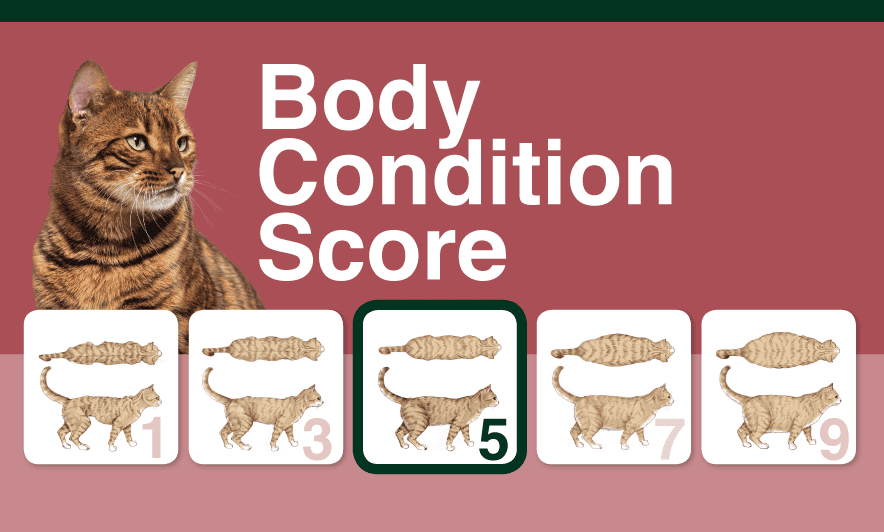
A 9-point BCS guide for cats
| BCS | Body condition | What you may notice |
|---|---|---|
| 1 | Under ideal | Ribs very easily seen on short-haired cats. No fat pads present. Severe abdominal tuck. Lumbar vertebrae and pelvic bones easily seen and felt. |
| 2 | Under ideal | Ribs easily seen on short-haired cats. Lumbar vertebrae obvious. Pronounced abdominal tuck. No fat pads present. |
| 3 | Under ideal | Ribs easily felt with minimal fat covering. Lumbar vertebrae obvious. Obvious waist behind ribs. Minimal abdominal fat pads. |
| 4 | Under ideal (for some breeds this is ideal) | Ribs felt with minimal fat covering. Noticeable waist behind ribs. Slight abdominal tuck. Minimal abdominal fat pads. |
| 5 | Ideal | Well-proportioned. Ribs felt with slight fat covering. Waist seen behind ribs, but not pronounced. Abdominal fat pad minimal. |
| 6 | Over ideal | Ribs felt with slight excess fat covering. Waist and abdominal fat pad present but not obvious. Abdominal tuck absent. |
| 7 | Over ideal | Ribs not easily felt through moderate fat covering. Waist not easily seen. Slight rounding of abdomen may be present. Moderate abdominal fat pad. |
| 8 | Over ideal | Ribs not felt due to excess fat covering. Waist absent. Obvious rounding of abdomen with prominent abdominal fat pad. Fat deposits present over lower back area. |
| 9 | Over ideal | Ribs not felt under heavy fat cover. Heavy fat deposits over lumbar area, face and limbs. Distention of abdomen with no waist. Extensive abdominal fat deposits. |
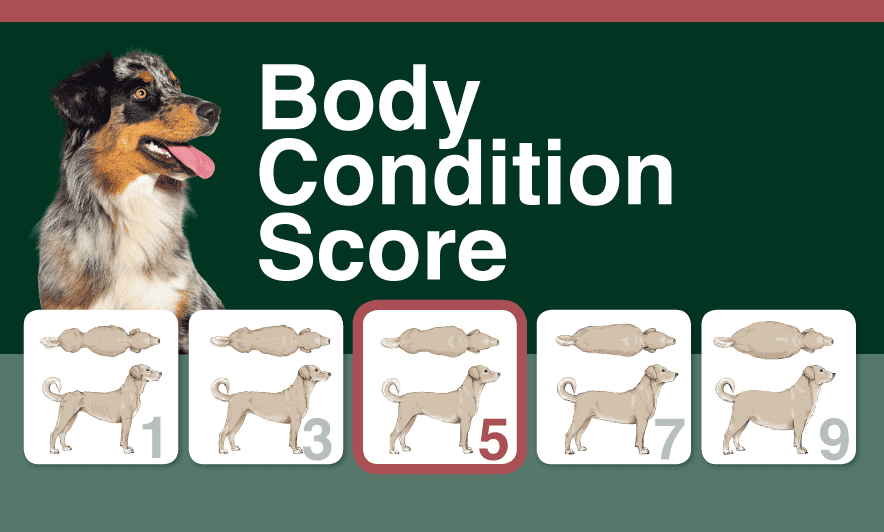
A 9-point BCS guide for dogs
| BCS | Body condition | What you may notice |
|---|---|---|
| 1 | Under ideal | Ribs, lumbar vertebrae, pelvic bones and all bony prominences evident from a distance. No discernible body fat. Obvious loss of muscle mass. |
| 2 | Under ideal | Ribs, lumbar vertebrae and pelvic bones easily visible. No palpable fat. Some evidence of other bony prominences. Minimal loss of muscle mass. |
| 3 | Under ideal | Ribs easily palpated and may be visible with no palpable fat. Tops of lumbar vertebrae visible. Pelvic bones becoming prominent. Obvious waist and abdominal tuck. |
| 4 | Ideal | Ribs easily palpable, with minimal fat covering. Waist easily noted, viewed from above. Abdominal tuck evident. |
| 5 | Ideal | Ribs palpable without excess fat covering. Waist observed behind ribs when viewed from above. Abdomen tucked up when viewed from side. |
| 6 | Over ideal | Ribs palpable with slight excess fat covering. Waist is discernible viewed from above but is not prominent. Abdominal tuck apparent. |
| 7 | Over ideal | Ribs palpable with difficulty; heavy fat cover. Noticeable fat deposits over lumbar area and base of tail. Waist absent or barely visible. Abdominal tuck may be present. |
| 8 | Over ideal | Ribs not palpable under very heavy fat cover, or palpable only with significant pressure. Heavy fat deposits over lumbar area and base of tail. Waist absent. No abdominal tuck. Obvious abdominal distention may be present. |
| 9 | Over ideal | Massive fat deposits over thorax, spine and base of tail. Waist and abdominal tuck absent. Fat deposits on neck and limbs. Obvious abdominal distention. |
Try the “rib, waist and tummy” check at home
You can do a quick assessment while your pet is standing comfortably.
- Feel the ribs. Run your hands gently over your pet’s ribcage. At an ideal body condition, you should be able to feel the ribs relatively easily without having to press firmly.
- Look from above. Your pet should usually have a visible waist behind their ribs rather than their body continuing outwards in a straight or rounded line.
- Look from the side. In dogs, you would normally expect the abdomen to tuck upwards behind the ribcage. Cats naturally have an abdominal fat pad, so their shape needs to be interpreted slightly differently.
Remember that thick or long coats can hide body shape surprisingly well, which makes using your hands particularly important.
What can we do if our pet is overweight?
Weight gain isn’t always as straightforward as avoiding feeding a pet large meals.
Treats, table scraps, chews and food used for training all contribute with calories. Multiple people feeding the same pet can also mean portions gradually creep upwards without anyone noticing.
A pet’s energy requirements can also change with age, activity level, neutering and health. That means the amount that maintained their weight a few years ago may no longer be right today.
Rather than dramatically reducing food yourself, speak to our veterinary team. Weight management should still provide the nutrients your pet needs, and calorie restriction that is too severe can result in loss of muscle as well as fat, or even liver damage, so try to avoid crash diets, especially in cats.
Small changes can make a big difference
Successful weight management is usually about creating habits that are realistic enough to maintain.
That might include weighing food rather than estimating portions, accounting for treats within the daily food allowance, using some of your pet’s normal food as training rewards and choosing exercise appropriate to their age, mobility and health.
For dogs, this might also mean gradually increasing suitable walks and play. For indoor cats, puzzle feeders, food-hunting games, climbing opportunities and short interactive play sessions can encourage activity while also providing enrichment.
Most importantly, monitor progress. Regular weigh-ins combined with BCS measurements can spot small changes before they become a bigger problem.
Worried about your pet’s weight? We can help
Our team can assess your pet’s current weight and body condition score, discuss feeding and exercise, set realistic goals and help to monitor progress along the way. Our registered vet nurses offer weight clinics, including free nurse consultations for members of our Heritage Health Plan.
Our aim is to help you find an achievable plan that works for your pet and your household. If you’re unsure whether your dog or cat is carrying a little extra weight, get in touch with our team.